Showing posts with label Fraser fir. Show all posts

Meet Dana Blais of Hidden Meadows Tree Farm in Bath


Dana and Jane Blais have been growing Christmas trees at Hidden Meadows Tree Farm in Bath since 1988. Over the past two decades, the Blaises have evolved from what Dana describes as “dabbling” in growing Christmas trees into a full-time business. Here’s what Dana had to say about his work when we caught up with him in November.


How did you get into Christmas tree farming?

“I more or less started around 1985. I’m trained as a forester, and at the time I was a county forester in Coos County. There’s quite a few Christmas tree growers in that area, and I just became interested in it. So I started to dabble in it a little bit. I like the land. I like farming. One thing led to another, and now I’m basically in it full time. It’s good work. I enjoy it. I still do some forestry work, but not a whole lot.”


How did you end up in Bath?

“My wife, Jane. She just happened to have some property here when I met her. I had my Christmas trees growing in several other locations, and this property is well suited to growing Christmas trees. So, we started growing trees here also.”


Do you still have trees in other places, too?

“Actually, now I don’t. I did buy land in Lancaster this spring, and I will begin to plant [there] in the spring of 2010.”


What is the size of your farm?

“Three hundred total acres, about 40 acres in trees. We are expanding. We have about 35,000 trees here now, and I think it’ll be another 10,000 or so. And I’ll be able to plant about 15,000 in Lancaster.”


What types of trees to you grow?

“Fraser, balsam and Canaan firs. I’ve dabbled in a few so-called exotics, and I continue to do that, but those three are the basics. I’m trying Korean fir now, and I think that has some promise.”


How many trees do you sell each season?

“Right now we sell an average of about 4,000 per year. We are open for choose-and-cut. We also sell into the wholesale market – Rotary clubs, fire departments. Jane and our daughter, Heather, also make beautiful wreaths, which we sell here.”


What is your favorite part of growing Christmas trees?

“I like all of it. I do like to put trees in the ground, to plant them. But I like the whole process.”


What is your least favorite part of growing Christmas trees?

“Dealing with diseases and insects. Sometimes it’s very difficult to control. The summers of 2007 and 2008, we had a tremendous amount of precipitation, which led to a big increase in a certain root disease. We’ve started putting in some subsurface drainage. Since Fraser is the most susceptible, I’m planting balsams and Canaans in some of those places.”


What do you like to do when you’re not working?

“I like to hike. I like it here in the mountains. And I hope the Patriots make it to the Super Bowl.”

Meet Mike Ahern of Glove Hollow Christmas Tree Farm in Plymouth


Glove Hollow Christmas Tree Farm (glovehollow.com) has been in the Ahern family since 1897. Fourth generation farmer Mike Ahern and his wife Karen now own and manage the 435-acre farm. Mike’s father Omer planted the farm’s first Christmas trees in 1957, and Mike and Karen’s four children, aged 1 ½ - 11 years old, also help out around the family operation. Here’s what Mike had to say about the family business when we caught up with him in October.

The farm has been in your family for a long time.

“It started off as a dairy farm. My dad planted the first trees 52 years ago, and he lived long enough to see the 50th anniversary. When he planted the first trees, he had a construction company. He did have dairy cows, but he sold off the dairy cows and went to work for the government. He retired after 29 years working for the Sullivan County Government. We actually grew up in Unity, New Hampshire. My two older brothers and my dad would always come back and take care of the trees. And I came when I got old enough to start working, in first grade. I’ve been shearing and working on the trees since I was probably 7 years old. I’m 44 now. I just couldn’t imagine doing anything else.”

When did you take over the operation?

“When I got out of college, it was like a magnet. When I got out in 1987, the economy was probably just as bad as it is now, so it was very easy to be able to come back and take care of the Christmas trees, because there was always work to do. At that time my dad was retired and doing most of the work himself. In 1994 I signed the paperwork to own the farm. My dad continued to help all the way up to 2007 when he passed away.”

Does your family help with the farm now?

“It really is a family thing. My wife has brought in the animals that our customers really enjoy seeing – four goats, two horses, rabbits. It really adds a lot to the flavor of the farm. People see the family connection when they get here. It’s not just a business – I guess you would call it a labor of love. Our kids are working right along beside us now, even though they’re still young. They’re getting the flavor of planting trees, and hopefully it will be in their blood like it was mine.”

What else is special about your farm?

“We’re all in one location – you actually get to visit one site and see 80,000 Christmas trees. There are mountains are all around the fields. The Hobo Railroad goes right through the center of our farm. One Saturday during the season, the train actually stops and the passengers get out and cut their Christmas tree and put it back on the cars to take with them. It’s kind of neat to see the train go right through the property. We also let customers take their vehicles right into the fields. Sometimes it’s their only chance to use their four-wheel drive.”

How big is your farm?

“Right now the Christmas tree portion is 172 acres, and there’s 260 acres of forested land. Our forest land is managed by a forester that’s been working with our family since the 1970s.”

What kinds of trees do you grow?

“We grow Frasers and Canaans. And we grow Fralsam – a cross between a Fraser and a balsam. We’re in a frost pocket and often get a late frost, so we’re forced to grow late-flushing trees, which just happens to be a couple of the best trees to grow.”

How many trees do you sell each year?

“We’re in a growth stage right now. We’ve always been about 43,000 Christmas trees in the ground, so we were selling 5,000-6,000 trees per year. Now we’ve got 80,000 trees in the ground, and we’re two years away from selling about 10,000 a year. We do cut-your-own and precut. We’ve got some people that have been buying their trees here for over 30 years.”

Do you sell anything else there?

“We sell wreaths. We mostly just concentrate on the trees. We never try to make anything commercialized here. We’re trying to be old fashioned and simple, but fresh.”

How many people work at the farm?

“We have kids that started off in high school that are still working with us. They know as much about the farm sometimes as I do. We have three fulltime seasonal employees and five or six others depending on what season we’re in.”

Do you have plans for any changes at the farm?

“We just added a tree house two years ago, overlooking the farm, with electricity and an observation deck. This year we added a couple of horse stalls and a paddock. It’s something that the public will be able to visit. As we get bigger and start handling more people, a lot of our ideas will hopefully become reality.”

What do you like most about your work?

“There’s always something different to do, and I really like that. I guess the best part about growing Christmas trees is the harvest, seeing all the customers come. It makes you feel like all the hard work you put into it really pays off. It really gets you psyched up for what you’ve done and what you’re going to do every year after.”

What’s the toughest part of growing trees?

“The real test is the patience you have to have to grow a really nice tree. We generally get the trees out 8-10 years after planning. The old timers will tell you, wait an extra year, don’t push it.”

What is something about growing trees that your customers might not realize?

“I think the attitude about Christmas trees has changed a lot in recent years. There are so many cut your own operations that have popped up, and they’re teaching their customers about it first hand. People really know the value of their tree.”

Meet Bill Nichols of Nichols Tree Farm in West Lebanon and Lyme

Bill Nichols and his wife, Srimalai, of Nichols Tree Farm have been growing Christmas trees for 40 years. They planted their first trees in 1969 on a 76-acre property they purchased after Bill got out of the Army. He was stationed for a time in Thailand, where he met Srimalai.
The Nichols’ operation now encompasses some 2,700 acres, a retail Christmas tree location in West Lebanon and a choose-and-cut outfit in Lyme, maple sugar operation, and firewood and timber production. We caught up with Bill in early October, as he was gearing up for the tree selling season. Here’s what he had to say.

How did you get started growing Christmas trees?

“It was kind of a high school age dream. I used to work in the woods when I was in high school. I recall having a discussion with one of the guys that I was working under, running survey lines out in the woods on some of the property that I now own, and I asked, ‘If you want to work out in the woods and make a living, how much land do you need?’ He said you probably need about 1,000 acres. I asked, ‘What’s the best way to get money off that?’ And he said Christmas trees and maple syrup, probably.”

That sounds like a lot of work.
“Oh, yeah. You can’t say I don’t work.”

Do you still do the maple sugaring, too?
“Yeah, I do a little bit of that. We sell a fair amount. We do 200-400 gallons a year.”

How much land did you start with?
“The house that we bought in ’69, there was 76 acres with the house. Cost me $23,000. I got my money back on that property. Actually, I’ve gotten my money back on most all the property I’ve bought. But most of it has been sweat equity. A lot of firewood. I work pretty late a lot of nights splitting firewood. The original property that we had, I sold off 50 acres of that. I had my sugarhouse there, which I kept, along with 26 acres of that property. There’s just a few Christmas trees on that.”

What kinds of Christmas trees do you grow?
“Mostly balsam and Fraser fir. We used to grow some of the other – spruces, Scotch pine, a little bit of Douglas fir – but all of those other things have not been profitable. They used to sell a lot better than they do now. We’ve got about 10 different farms. Some of them aren’t too big. Others are fairly good sized. The smallest acreage of Christmas trees is probably a couple of acres, and the largest would be about 60 acres of Christmas trees.”

How many trees do you sell in a typical year?
“There really isn’t a typical year. We planted land as it became available or we made it available. Right now we’re at a fairly low production. We’ll probably only do about 8,000 or so this year. Three years ago we did about 14,000. Three years from now we’ll be up around 20,000. We’ve planted a lot of trees in the last five years, so we have a lot of stuff coming in. We’re going to start scaling back. Next year will be the last year that we plan on doing much planting. I’m getting a little old – I’m 63. It’ll take 10 years to get those trees we plant next year.”

How many people do you have working there?

“A lot of my wife’s relatives from Thailand work as legal non-immigrant farm labor. We normally start bringing them in in April for planting, and they go home in December.”

What’s been most enjoyable in your work?
“I find it very rewarding when everything is going good, which is mostly dependent on labor issues. Anybody that’s running a business will tell you that one of the biggest headaches is managing your people and getting good production out of them. And when everything goes good, it’s nice. The business if fun when everything goes smoothly.”

What is something your customers might not know about growing Christmas trees?
“Most people don’t realize the work that goes in it. They think you just stick a tree in the ground and a few years later you cut it and sell it. But you have to take care of every tree every year – fertilize, weed control, mow the grass, shear the trees, watch out for insects, drought, disease.”

Do you ever have any time off?
“I do a little fishing sometimes. I used to do a little hunting, but the hunting conflicts with the harvest season. I relax when I have the time I guess.”

Meet Mike Godzyk of Sibgo Tree Company

Michael Godzyk took over operation of the Sibgo Tree Company (www.sibgotree.com) in Colebrook from his father in 2001. His dad started the farm with another tree farmer back in 1969. Mike manages a total area of about 200 acres and sells about 10,000 trees each year.
He’s been working on the farm and learning the trade since he was a kid, and has college degrees in both landscape nursery management and landscape horticulture. His four-year-old son is already learning how to plant Christmas trees on the farm.
Last year Mike took state champion for trees and reserved grand champion honors at the annual Big-E fair. Here’s what he had to say when we spoke September 8.

How big is the farm?
My whole farm together is about a 200-acre farm. I have about 60-70 acres of workable trees, and another 75-80 acres planted on leased property. The rest of the land is a little wetlands area and forested areas.

Does the business include anything other than Christmas trees?
I also have a side business where I do ball and burlap trees with the Premier tree spade. I do that in the spring and fall. I’m actually trying to expand a little bit. I’m doing some potted trees, and I’m going to do shrubbery and potted shrubs. It’s growing them right in the ground in a pot, so you can just take them right out when they’re ready. Some Christmas trees, but also landscape plants like maple trees.

What types of Christmas trees do you grow?
I grow mainly Fraser fir, probably 80 percent. Probably 5 percent is a Fraser-balsam cross, and the remainder is balsam fir. I grow my stuff right from seed. I’ve selected seed from certain seed trees – a bluer tree. It’ll flush a little bit later – that means it will be more disease resistant. We’re playing around with some other stuff, too, called exotics. One that I’m really interested in is a Korean-balsam cross. I have a bunch of Korean firs that are about eight years old, and I’m just going to use those as a seed orchard.

What’s the process for harvesting seeds?
You pick the cones and put them up to dry, then have to sift them through a couple of screens. Then you have to blow all the unwanted material out of it, and you’re pretty much left with a pure seed. Then you put it in the seed bed. I like to do that in the fall, because the thawing and freezing process will help stratify the seed coat.

How many people are on your staff?
My wife, Lisa, helps be quite a bit with the bookwork and whatnot. During harvest season, I’ll get about 20 guys in here at a time. Harvest season only runs about November through December. My other big time is during shearing season, when we prune the trees, and that starts in July and goes through Labor Day. I basically use high school kids for that, and I get about 10-12 guys. During the spring planting season I’ll have about five guys, and we’ll put in about 20,000 trees per year.

How many Christmas trees do you sell each year?
About 90 percent is wholesale. The other 10 percent is retail. I don’t do choose and cut, because I have two retail lots, in Manchester and Raymond. I usually sell anywhere from 10,000 to 15,000. I buy in a couple thousand trees, too.

What do you like best about running a tree farm?
Just being my own boss and being able to go out and do what I have to do to make it work. I like every part of it. I wouldn’t want to do anything else, ever. My favorite part is probably harvest season, though, when everything gets ramped right up. I get an adrenaline rush out of it.

What are some of the challenges you face as a tree farmer?
I’ve had a major moose problem on one of my lots. I’ve probably lost about $50,000 worth of product. We’ve dealt with moose problems in the past. You just expect a little bit of a loss here and there. But last year it was a major problem.

What do you do when you’re not working at growing trees?
Basically in the wintertime I plow snow and go snowmobiling, just to keep myself busy. That’s basically the only thing we can do up here.

What is something about Christmas trees that the average consumer probably doesn’t know?
The whole maintenance and care of the tree to bring it through its whole cycle: the seed selection, how to get your nursery going, the planting, the chemicals that you have to use, your licensing, the equipment that you need. From seed to get in the field is basically five years. After it’s in the field, it takes another five to 10 years.

Meet Dan Beloin of Beloin Tree Farm

Dan Beloin is a second-generation tree farmer in Colebrook. He took over the farm from his father, Eugene, in 1991 and has since sold portions of the 500-acre Beloin Tree Farm property to brothers Fernand and Ronnie. Each brother manages his own section, but they share equipment and other resources.

The Beloins have 250 acres planted in trees, mainly Fraser and Balsam firs, with a few other species also in the mix. The remainder of the property is working forest, and the family harvests some lumber each year. The farm has been in the Beloin family since Eugene purchased the land in 1948. He used to run a small dairy farm there, as well.

Two other retired brothers and a nephew also work the farm, as does Eugene, now 89 years old. A sister, Emily Langford, has a wreath business, Emily’s Wreath Factory, in nearby Northumberland, and supplies Dan’s retail stand with wreaths. (There are six Beloin brothers and seven sisters altogether!)
Dan is also a director of the New Hampshire-Vermont Christmas Tree Association. We caught up with him in July, when a series of rain storms had chased him inside:
With so many family members working together, how does that dynamic play out?

We each own our own section. We’re all growing trees, but we all share the equipment and work together. It works well. I’m the biggest mouth, I guess – I’m the salesman for all the trees. We put all our trees in under the Beloin Tree Farm name. It gives us a better selection for our customers – we have a much better inventory for the buyers.
Do you all grow the same types of trees?
Basically my two brothers grow Fraser and Balsam. I’ve expanded into blue spruce, Korean Fir, Turkish Fir, different things. I have a big retail stand, too, so I offer different things there. On the retail end it’s trees and wreaths, kissing balls, roping and that kind of thing. My sister is the wreath expert. She makes a lot more wreaths than what we can handle. She’ll buy brush from us, and we buy some of her wreaths.
How many trees to you sell on average in a year?
We’re real close to 10,000. I’d say in five years we could be closer to 20,000. We’ve got a lot of acres of 4-foot-high trees right now. Last year I shipped as far as Colorado. I have shipped to Florida before, and Texas. But 80 percent of the trees stay in New Hampshire. Ronnie has a choose-and-cut operation, because he’s right on Route 3. I have a retail outfit in Bedford and sell about two trailer loads (1,200-1,400 trees) there. The rest are all wholesale – tractor trailer loads to nurseries or whoever. Feed stores, ice cream shops.
How many people to you have working for you at the farm?
I have one full time, and he’s my nephew. So, we actually have three generations working together. My dad’s 89 and he’s still puttering, doing whatever he can. At 89 he’s a little bit slower, but he’s always doing something. When it comes to harvest, I can have as many as 15 men working.
When did you start working on the tree farm?
I can remember not being able to drag a tree but trying anyway. We had a dairy farm here up until 1982. We sold off the cows and just kept expanding on the Christmas trees.
What do you enjoy most about your work?
The diversity of the work. You don’t get stuck in a rut of doing just one thing. Sometimes you’re a mechanic, sometimes you’re an electrician, sometimes you’re whatever. There’s shearing, then there’s mowing, and then there’s spraying and fertilizing. You’re changing jobs every day, every week.
What is the most difficult aspect of the job?
The most boring job that I would rather pass off but can’t is inventory – actual flagging of the trees to know what we have for sale. The biggest challenge is maintaining a certain level of production. You can always go up. But if you start backsliding and losing customers, then try to regain them two-three years later, that’s hard. Also, dealing with the elements. This summer, totally out of my control, the rain. I’m going to have to buy fungicides for the first time in my life. My blue spruce are being attacked. Mother Nature leads and I just follow.
What do you do for fun?
Work. It’s six days a week, pretty much. It’s very time consuming. You’ve got to pay attention. The biggest slack time is after Christmas. We don’t do anything for two or three weeks, just because. I also like hunting, fishing.
Do you have any changes planned at the farm?
The biggest asset of all is knowing what’s going on in the industry, keeping up to date with new trends, new ideas, new techniques. I like to branch out a little bit to different kinds of trees, just to experiment a little bit. It’s always changing. I guess the biggest challenge is to keep up with it. It’s a continuing education. If you don’t keep up with things, you fall behind.
What is something you think the average Christmas tree buyer may not know about tree farming?
They don’t realize the amount of time involved. They think you just put it in the ground and wait ten years. I have to touch every tree at least four times a year. There’s a million touches going on every year. It’s year-round business. As soon as the snow melts, we’re out there base pruning or spraying or whatever it takes to get things going. It’s a hard business to get started. You’ve got to put in for 10 years before you get something out.
It must be nice for your dad to see the farm still in operation and still in the family.
I’m sure it puts a lot of pride in his heart. I’m not doing this because I’m stuck here. I want to be here. I suppose if I was to cut my arm, I’d probably bleed tree sap.
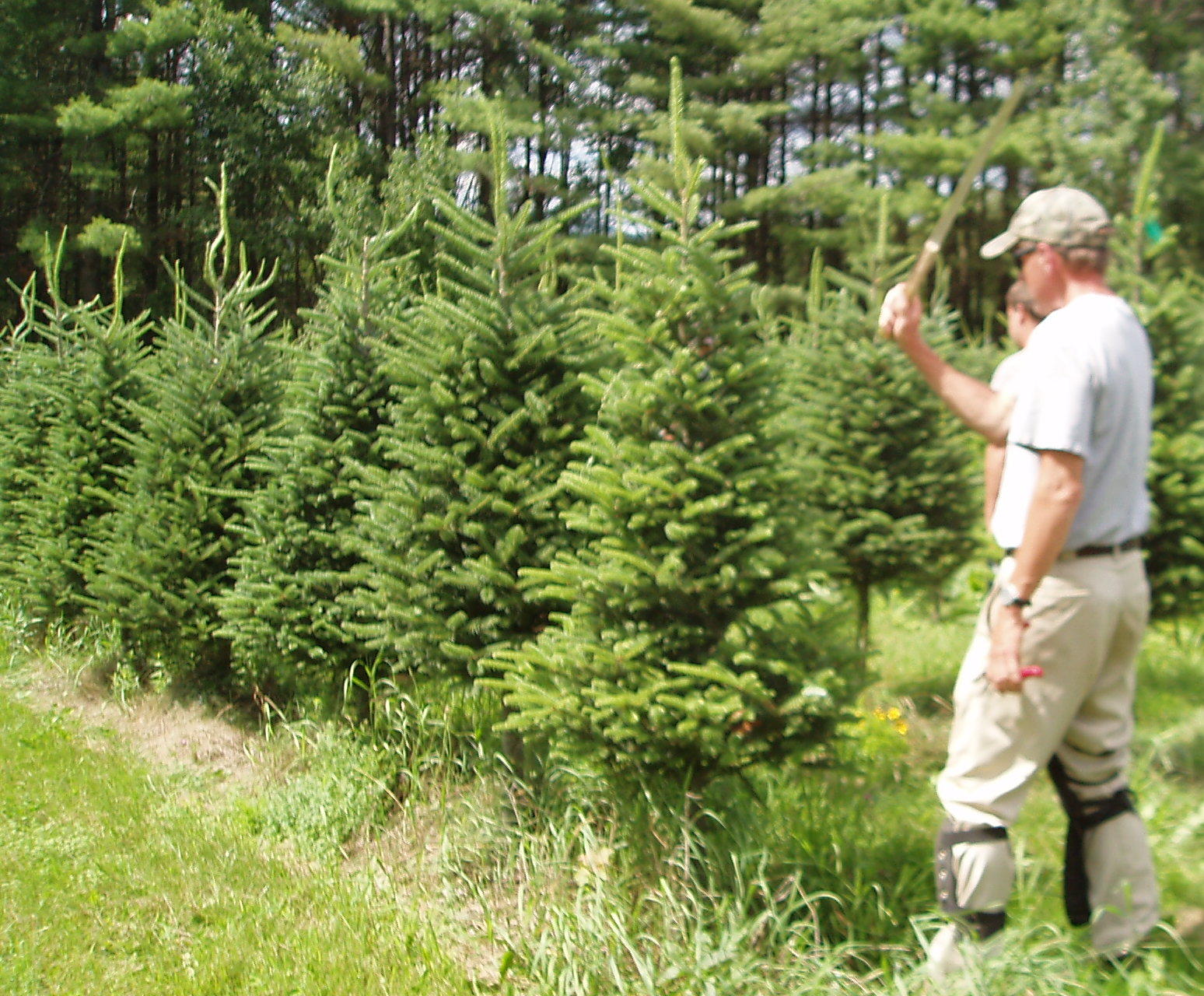
Meet Gordon Page Of High Meadow Farm


By Meghan McCarthy McPhaul

Gordon and Carolyn Page grow Christmas trees on about 4½ acres on their Strafford property. With 10 acres in current use, including the Christmas trees, the other space is occupied by large vegetable and flower gardens and several fruit trees.

“We’re situated at the edge of the Blue Hills area. We’re up at an elevation of 860-plus feet,” Gordon says. “We’re kind of a microclimate.”

Gordon, a civil engineer who retired 16 years ago from the N.H. Department of Environmental Services, and Carolyn, a retired educator, got into Christmas tree farming as “a retirement project.” They planted their first trees in 1989 and have been selling trees since the mid-1990s.
T
hey harvest about 400 cut-your-own Christmas trees each year.

We caught up with Gordon June 5 to talk about his retirement project. Here’s some of what he had to say:

Where did you get the idea to start a Christmas tree farm?

My wife has sister-in-law in New Jersey that did it, and we had this land. About 3 acres was in woods. The rest was a former pasture for a horse farm. It’s real flat. The land wasn’t being used for anything, so I thought this would be a fun project.
What kinds of trees do you grow?
I’ve planted quite a few varieties: Fraser fir and balsam, Canaan fir (a balsam that’s native to West Virginia). I’ve got 650 Korean firs now.
How do you decide what kinds of trees to plant?
I’ve had problems the last couple years with root rot with Fraser firs. That’s why the last couple of years I’ve switched to the Canaans and the Korean firs, which are supposed to be resistant. I have a real heavy soil here, and the Canaans do well in heavy soil.
How did you learn about tree farming?
I became active in the marketing committee for the New Hampshire-Vermont Christmas Tree Association. And I picked everybody’s brains every time I’d go to a meeting. I actually made quite a few mistakes in the beginning. The first trees I planted were white spruce, which I found out most people don’t like. I planted about 1,000 of those. Then I planted Scotch pine, which people also don’t like. I finally got to balsam and Fraser firs. We’ve put up an electric fence – the first 500 balsams I planted, the deer devastated them.
Do you have a hired staff?
It’s mainly my wife and me. The last two years we had a friend from Sacramento, California, fly out to help us. He thinks it’s great to be in the tree business at Christmas time. Generally we have one teenager helping us during the selling season.
When does your busy selling season start?
People start coming to tag trees Columbus Day weekend. We start selling Thanksgiving weekend. Carolyn makes a couple hundred wreaths and decorates them to sell. She starts about November 1st making wreaths. You’re supposed to wait until after the second frost to start cutting brush.
Have you been happy in your retirement project?
Yeah. It’s small enough so that if I want to take off and go fishing or something I can do it. There’s nothing to do in January, February and March. It’s about mid-April when you get busy. Last year we went to New Zealand for three weeks in January. We’ve done a lot of shorter trips in the summer.
What’s your favorite part about raising Christmas trees?
I like to be outdoors. That’s one of the reasons I took up civil engineering, but I found myself in an office most of the time. Seeing the people each year. Most of our customers are pretty loyal, they keep coming back. And seeing their kids grow up.
What is something that you don’t enjoy as much?
All the mowing. I try to keep the grass mowed between the trees. That keeps me busy in the summer. There’s the shearing in the spring. But I don’t really mind those things.
What is something the average Christmas tree buyer might not realize about growing trees?
I suppose that they don’t think about that the trees are giving off oxygen. And they preserve the land, which is very important, especially in southern New Hampshire.
What do you do besides raise Christmas trees?
I hunt. Both of us are involved in the Bear-Paw Regional Greenways (a regional land trust). It started out trying to get a greenway between Bear Brook State Park and Pawtuckaway State Park. They’re active in Rockingham and Strafford counties. And I’ve climbed the 100 highest peaks in New England. I’ve climbed New Hampshire’s 48 4,000-footers in winter. Carolyn’s climbed all the New England 4,000-footers. That was in our younger years. We still hike, but we’re not that serious anymore.